Research|Issue 04
Cosmic Mirrors: Webb Reveals Distant Galaxies Through Gravitational Lensing
The James Webb Space Telescope captures a galaxy cluster that acts as a colossal lens, bending light to reveal hundreds of previously unseen galaxies from the early universe.
- By
- ARTEMIS TOKYO Editors
- Dateline
- Paris, France
- Date
- September 29, 2026
- Time
- 7 min read

The James Webb Space Telescope (JWST), a collaborative effort by NASA, ESA, and CSA, has unveiled a striking image of the galaxy cluster MACS J0454.1-0300. This celestial tapestry showcases galaxies that appear warped and multiplied, as if stepping into a cosmic house of mirrors.
The phenomenon at play is gravitational lensing, where the immense mass of a foreground object, such as this distant galaxy cluster, bends and magnifies light from even more remote objects behind it. The cluster itself is immensely distant, offering a view of the universe as it was approximately eight billion years ago.
Astronomers report that the orange galaxies concentrated on one side of the cluster are not actually part of MACS J0454.1-0300, but are far more distant background objects whose light has been dramatically distorted. The universe, in its vastness, sometimes offers glimpses of its own hidden architecture through these cosmic distortions.
"The gravitationally lensed areas show multiple images of galaxies from when the Universe was young: a group of galaxies 2 billion years after the Big Bang, and a single galaxy just 800 million years old after the Big Bang."
Within these magnified regions, astronomers have identified individual bright 'knots' corresponding to areas as small as five light-years across. These minute clumps appear magnified by a factor of more than 300 in some instances, providing an unprecedented view into the early stages of star formation.
A comparison with a 2014 image of the same cluster taken by the NASA/ESA Hubble Space Telescope reveals the dramatic leap in observational capability. The new Webb image uncovers hundreds of galaxies that were entirely missing from the earlier view, demonstrating JWST's superior sensitivity to the redder light emanating from these ancient, distant sources.
For those who will one day live within the confines of off-world habitats, such images offer a profound sense of perspective. They underscore the immense scale of the cosmos, reminding inhabitants that even as they forge new societies beyond Earth, the universe remains an endless frontier of discovery. The technologies refined for these deep-space observations—from ultra-precise optics and cryo-cooled sensors to advanced data processing—will inevitably find application in the design and maintenance of self-sustaining orbital or planetary settlements, in remote sensing for resource identification, or in the creation of immersive cultural experiences that bring the distant cosmos into their enclosed worlds. It suggests a future where the act of looking out into the universe becomes intrinsically linked to the art of living within it.
Related Reading
Research
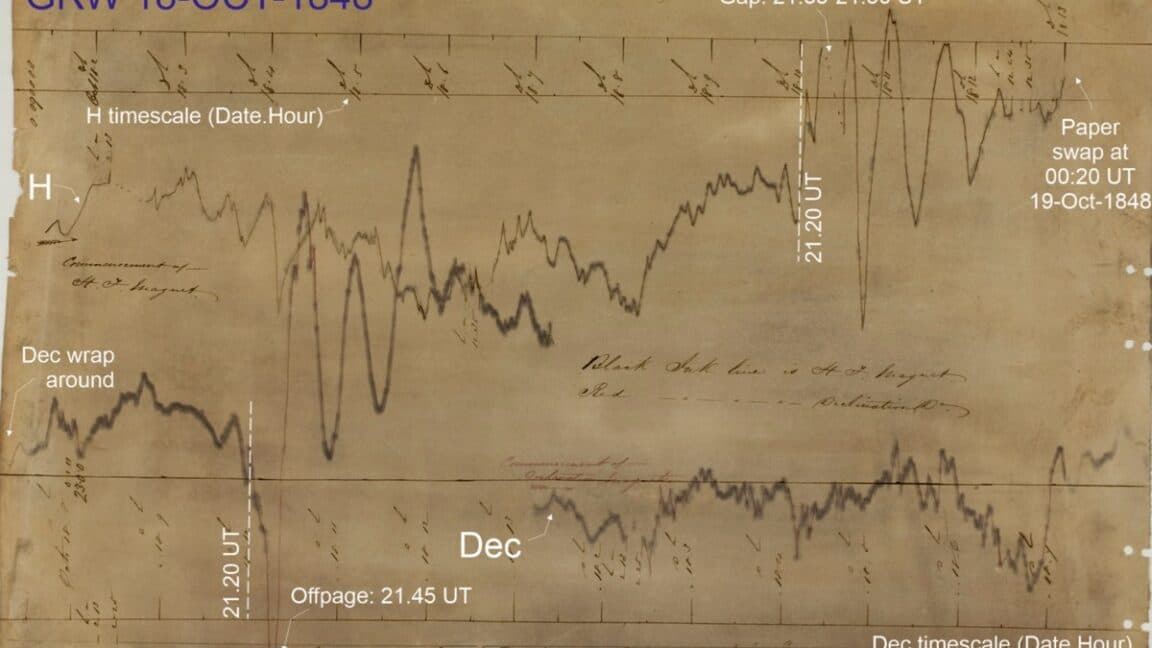
Echoes of the Sun: Unlocking 19th-Century Space Weather
New research illuminates a forgotten 1840s geomagnetic event, offering critical insights into solar dynamics and the resilience of future off-world habitats.

Research
Venus's Ghost Moon: A Tale of Celestial Cannibalism
New scientific hypotheses suggest Venus may have once possessed a moon, only to consume it through immense tidal forces, reshaping our understanding of planetary evolution and stability.
Research
NASA's PRIMA: Accelerating the Cosmos
NASA aims to construct a billion-dollar space telescope in record time, setting a new precedent for complex scientific instrument development and deployment.