Research|Issue 04
Echoes of the Sun: Unlocking 19th-Century Space Weather
New research illuminates a forgotten 1840s geomagnetic event, offering critical insights into solar dynamics and the resilience of future off-world habitats.
- By
- ARTEMIS TOKYO Editors
- Dateline
- TOKYO
- Date
- September 28, 2026
- Time
- 5 min read
Source
Ars Technica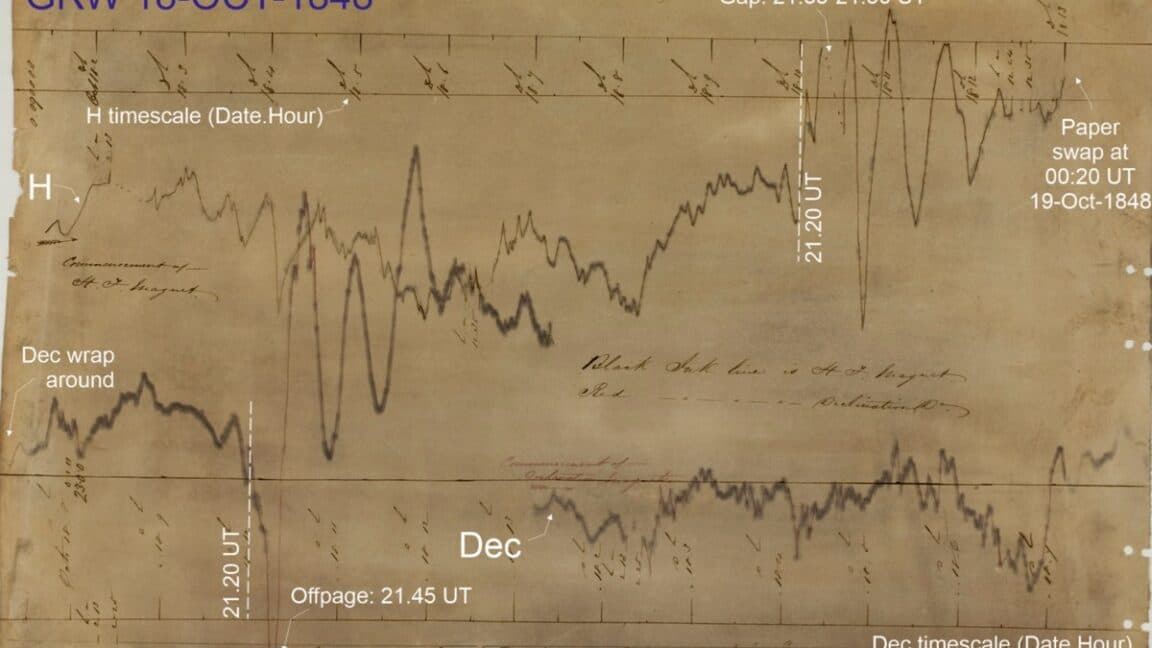
The silent archives of history often hold keys to future challenges. Researchers have recently turned their attention to the mid-19th century, uncovering new details about a geomagnetic event from the 1840s that had largely faded from scientific memory.
This newly understood disturbance, though less severe than the infamous Carrington Event of 1859, provides a crucial historical data point. It offers a clearer picture of the sun's volatile nature and its capacity to impact Earth's magnetic field long before the age of modern electrical grids and satellite constellations.
Scientists meticulously analyzed old observatory logs, ship manifests, and even handwritten accounts of aurora sightings from across the globe. This painstaking work allowed them to reconstruct the scale and characteristics of the solar storm, revealing its distinct signature.
"The 1840s event, though smaller than the Carrington Event, offers a critical data point for understanding solar dynamics."
The findings suggest that such significant space weather events are not isolated anomalies but rather integral parts of the sun's cyclical behavior. Understanding these historical occurrences refines our models for predicting future solar flares and coronal mass ejections.
For those on Earth, this improved foresight means better protection for power grids, aviation, and the sprawling network of satellites that underpin global communication and navigation. It mitigates the risk of widespread outages and infrastructure damage.
Yet, the implications extend far beyond Earth's protective magnetosphere. As humanity ventures off-world, establishing permanent outposts on the Moon, Mars, and in orbital habitats, the threat of space weather becomes a direct concern for daily life.
The design of lunar habitats, the shielding of Martian settlements, and the operational protocols for orbital stations will all be informed by this deeper understanding of solar activity. It ensures that the very fabric of off-world existence – from structural integrity to communication lifelines – is built with resilience against the sun's unpredictable temperament.
Related Reading

Research
Venus's Ghost Moon: A Tale of Celestial Cannibalism
New scientific hypotheses suggest Venus may have once possessed a moon, only to consume it through immense tidal forces, reshaping our understanding of planetary evolution and stability.
Research
NASA's PRIMA: Accelerating the Cosmos
NASA aims to construct a billion-dollar space telescope in record time, setting a new precedent for complex scientific instrument development and deployment.

Space Tech
Boeing Starliner Resets Course After 2024 Incident, Crewed Flight Pushed to 2028
After a critical test flight in 2024 left astronauts stranded on the ISS for nine months, Boeing's Starliner capsule undergoes significant redesigns, with its next uncrewed flight scheduled for December and a crewed mission now targeting 2028.