Space Tech|Issue 04
Blue Origin Contract Expansion Signals Future of Rocket-Powered Global Logistics
The U.S. Air Force has increased its contract with Blue Origin to study point-to-point cargo delivery via space rockets, hinting at a new era for rapid terrestrial transport and off-world supply chains.
- By
- ARTEMIS TOKYO Editors
- Dateline
- Washington D.C.
- Date
- August 2, 2026
- Time
- 5 min read
Source
SpaceNews
The concept of global logistics is undergoing a quiet but profound re-evaluation. While traditional air cargo routes crisscross continents, a new vision for rapid transport is emerging from the realm of spaceflight, promising to redefine how critical goods move across the planet.
Blue Origin, known for its reusable rocket technology, has seen its contract with the U.S. Air Force Research Laboratory expanded. This expansion, valued at an additional $11.7 million, is dedicated to exploring the feasibility of point-to-point cargo delivery using space rockets.
This initiative moves beyond the traditional satellite launch model. Instead, it envisions rockets launching from one location, delivering payloads to another distant point on Earth, and then returning for reuse. It is a proposition that could dramatically reduce transit times for time-sensitive goods.
The study focuses on the engineering challenges and operational protocols required to make such a system viable. This includes considerations for launch infrastructure, re-entry procedures, and precise landing capabilities that would allow a package to arrive swiftly and safely, perhaps in a remote desert outpost or an island nation.
"The Air Force Research Laboratory increased by $11.7 million Blue Origin’s contract to study the use of space rockets for point-to-point deliveries."
While the immediate application is likely military logistics, the underlying technology has broader implications. It lays groundwork for a future where high-value, time-sensitive cargo can traverse oceans and continents in a fraction of current delivery times, fundamentally altering global supply chains.
For those contemplating life beyond Earth, this development holds particular resonance. The ability to rapidly move resources across vast distances on Earth directly informs the logistics required for lunar or Martian settlements. Imagine a future lunar base receiving urgently needed equipment from another far-flung outpost on the same celestial body, mirroring the precision and speed being developed today. This terrestrial innovation in rapid cargo movement is a precursor to the intricate supply chains that will sustain permanent off-world communities, changing how goods are valued and moved in extraterrestrial economies.
Related Reading
Space Tech
Lunar Habitats Evolve: A Glimpse into Off-World Domesticity
A new modular lunar habitat design promises expanded living volumes and a focus on human comfort, hinting at a future where off-world spaces are not just functional but also profoundly livable.

Space Tech
K2 Space Secures Space Force Contract for Orbital Laser Communications
The U.S. Space Force awards K2 Space a $22.9 million contract to demonstrate high-speed, secure optical data links between satellites, signaling a shift in orbital communication infrastructure.
Space Tech
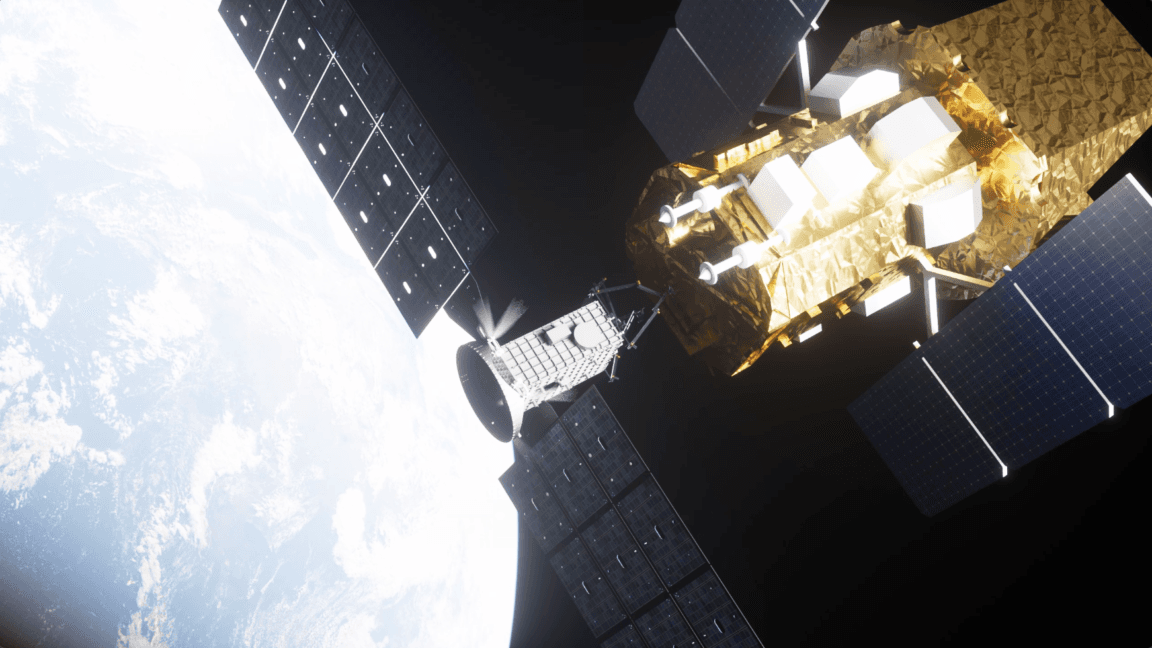
Orbital Rescue: The Mission to Save the Savior Satellite
Engineers are devising an unprecedented plan to recover a servicing satellite that itself encountered operational difficulties, highlighting the intricate challenges of maintaining space infrastructure.