Research|Issue 04
The Universe's Shifting Constants: A Cosmic Discrepancy Persists
New research exploring a variable electron mass attempts to reconcile the Hubble tension, revealing the enduring complexities at the heart of cosmic measurement.
- By
- ARTEMIS TOKYO Editors
- Dateline
- Tokyo, June 4, 2026
- Date
- June 4, 2026
- Time
- 4 min read
Source
arXiv
The universe's expansion rate remains a profound enigma. Measurements from the early cosmos diverge from those taken in the present epoch, creating a persistent "Hubble tension" that challenges our foundational cosmological models. This discrepancy hints at physics beyond our current understanding.
Recent work explored a radical possibility: a subtly time-varying electron mass during the universe's recombination period. Such a modification would alter how light from the early universe reached us, potentially aligning disparate observations. The proposal offered an intriguing, if complex, solution to a fundamental problem.
Initial findings suggested that this "perturbative modification to $m_e(z)$" could indeed fully resolve the tension when considering early universe data alone. The proposed electron mass exhibited an "oscillatory structure," implying a universe more dynamic at its very core than previously conceived.
"perturbative modifications to $m_e(z)$ cannot fully resolve the Hubble tension."
However, the picture changed with the inclusion of later-time cosmological observations. Data from the Dark Energy Spectroscopic Instrument (DESI) introduced new constraints. These observations indicated that a variable electron mass, while easing some discrepancies, could not fully reconcile the conflicting measurements without introducing new inconsistencies regarding the universe's matter density. The fundamental limitation persists.
This unresolved tension is not merely an academic puzzle. For those contemplating lives off-world, a precise understanding of cosmic parameters is paramount. Whether navigating interstellar distances or designing self-sustaining habitats, the foundational constants of physics inform every calculation. An enduring uncertainty at the universe's largest scale means that the very maps and clocks used for deep-space endeavors carry a subtle, yet profound, unknown. It implies that even the most meticulously engineered off-world settlements will exist within a cosmos whose fundamental rhythm we are still learning to discern.
Related Reading

Research
Refining the Search for Distant Worlds
A new generative spectral modeling framework, AESTRA II, promises to significantly enhance the detection of Earth-analog exoplanets by filtering out stellar activity noise, bringing clarity to the search for habitable zones.

Research
Tracing Interstellar Whispers: JWST Observes 3I/ATLAS
The James Webb Space Telescope's detection of gas from an interstellar comet offers new insights into cosmic chemistry and the subtle atmospheric realities awaiting off-world inhabitants.
Research
MAVEN’s Quiet Departure from Mars
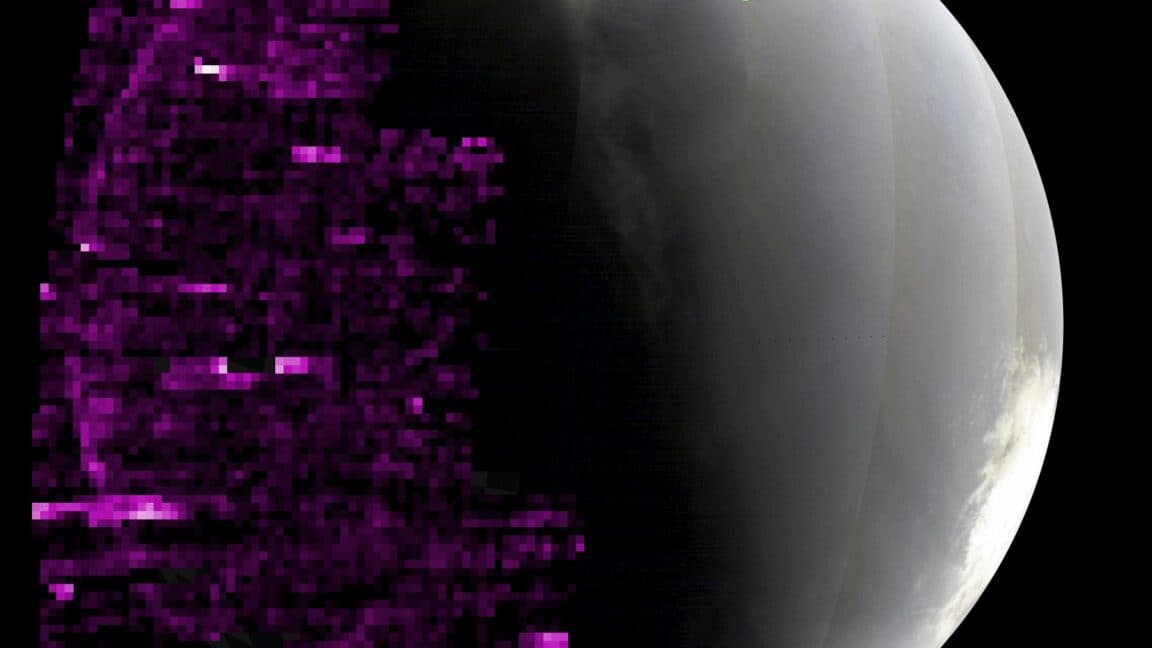
After eleven years, NASA’s MAVEN spacecraft concludes its mission, leaving behind critical data on Mars’s atmospheric past and a blueprint for future off-world habitability.