Research|Issue 04
A Magnetic Embrace: Worlds Bound by Stellar Fields
Recent astronomical observations reveal exoplanets in such extreme proximity to their host stars that their magnetic fields merge, creating a dynamic, volatile environment unlike anything in our solar system.
- By
- ARTEMIS TOKYO Editors
- Dateline
- Tokyo, June 25, 2026
- Date
- June 25, 2026
- Time
- 5 min read
Source
Ars Technica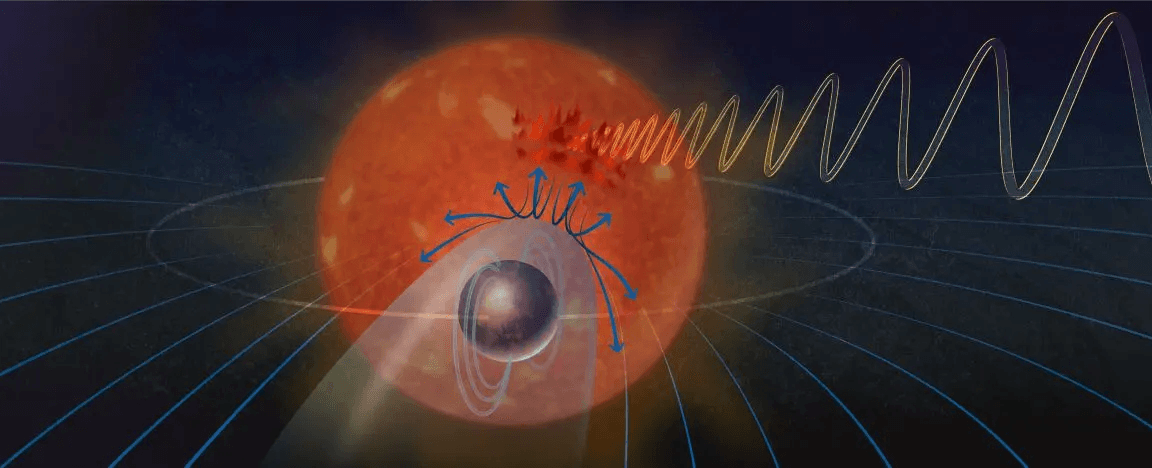
In the vast tapestry of exoplanetary systems, certain celestial bodies defy our conventional understanding of planetary dynamics. Astronomers observing distant star systems have recently turned their focus to a phenomenon where a planet orbits its host star with such extreme proximity that their powerful magnetic fields directly interact.
This intimate stellar-planetary relationship transcends mere gravitational pull, manifesting as a direct connection between the magnetic fields of the two bodies. Imagine two colossal magnets, locked in a perpetual, high-energy embrace, their lines of force intertwining and reconnecting in a constant cosmic dance.
Such a configuration, often involving gas giants orbiting red dwarf stars, leads to intense energy transfer. Plasma from the star can be siphoned towards the planet, generating powerful auroral displays hundreds of times brighter than Earth's, and potentially stripping away the planet's atmosphere over cosmic timescales. The orbital period of such a planet can be as short as 18 hours, placing it less than two million kilometers from its stellar parent.
Observations leveraging advanced spectroscopic techniques and radio astronomy have provided the crucial data to infer these magnetic linkages. Researchers analyze subtle shifts in stellar light and characteristic radio emissions to map the invisible forces at play, revealing a new dimension to star-planet interactions.
"Planet orbits so close to its star that their magnetic fields connect."
This discovery offers a profound insight into the diverse evolutionary paths of planetary systems. While Earth’s magnetosphere provides a crucial shield against the Sun’s solar wind, the interaction observed in these extreme systems is far more violent, fundamentally shaping the planet's very existence.
For those contemplating life beyond Earth, these findings underscore the sheer range of environments that exist. Understanding such powerful, systemic forces is paramount, not just for scientific curiosity, but for informing the design principles of any future off-world habitat. Even if direct human settlement on such magnetically bound worlds remains distant, the lessons learned about resilience in extreme radiation and plasma environments will be invaluable for designing structures and life support systems capable of enduring the challenges of space, from lunar regolith to Martian dust storms.
Related Reading

Research
The Distant Prospect: Settling Saturn's Icy Moon
A NASA scientist's argument for human habitation on a Saturnian moon prompts reflection on the immense challenges and profound implications of building new societies in the outer solar system.

Research
Deep Listening: A New Era for Radio Astronomy
A new generation of radio telescope in the Nevada Desert promises to transform our understanding of the cosmos, moving from conceptual sketches to detailed photographs of distant phenomena.

Research
Understanding the Sun's Breath: NASA's New Space Weather Mission
NASA selects a new mission to study how solar phenomena interact with Earth’s atmosphere, laying groundwork for off-world resilience.